26. April 2026
Why Your 'Leather' Sofa Is Peeling: The Bonded Leather Problem No One Warned You About
If your "leather" sofa started flaking off in chunks after three to five years, leaving little brown shavings on your floor and embarrassing patches of cloth showing through, you are not alone — and the problem isn't you, your conditioning routine, or your kids. The problem is that you don't actually own a leather sofa. You own bonded leather. Here's what that means, why no one warned you, and what your realistic options are now.
What bonded leather actually is
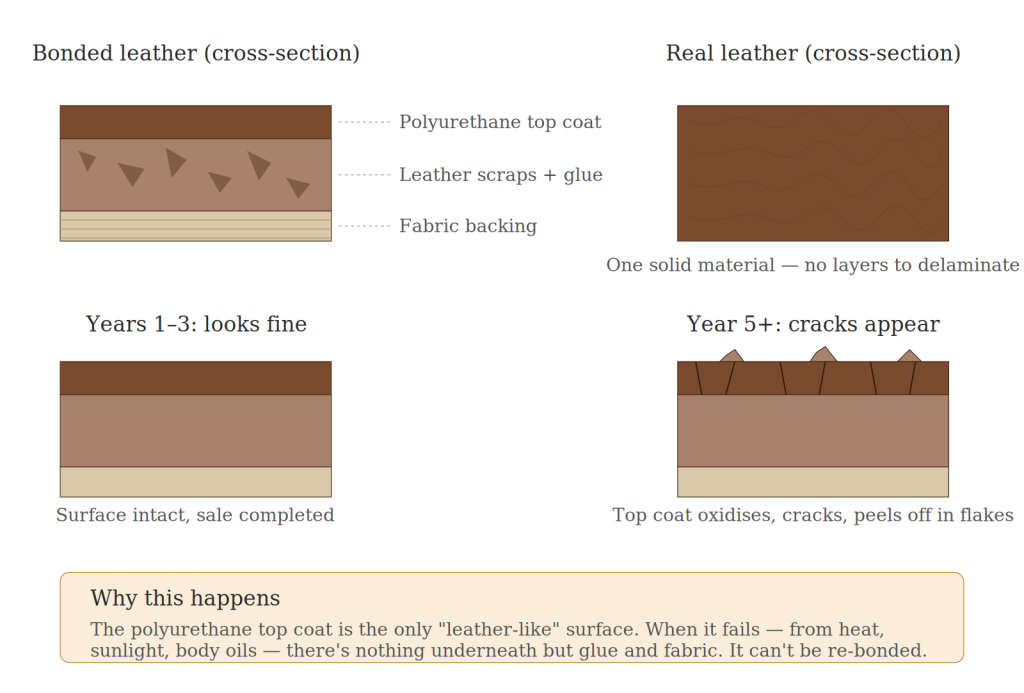
Bonded leather is to real leather what processed cheese slices are to cheddar. It's leather scraps and offcuts ground into a slurry, mixed with polyurethane and adhesives, and rolled out as a thin layer onto a fabric backing. The visible "leather" surface is between 10% and 20% genuine leather fibres at most. The rest is plastic and glue.
It looks identical to real leather when it's new. It feels almost identical for the first couple of years. Then the polyurethane top coat starts to oxidise — usually triggered by body warmth, sunlight, and skin oils on the parts you actually sit on — and it begins to crack, then peel, then flake away in irregular brown sheets. Once it starts, it doesn't stop. Within a year of the first crack appearing, most of the seating surface is usually shredded.
How to tell if you've got bonded leather
If you've already got the peeling, you've already got your answer. But if you're trying to identify a sofa before buying second-hand, or you're checking what you bought five years ago before it starts to fail, here are the tells:
The receipt test (easiest)
Find your original purchase paperwork or the manufacturer's website listing. Look for any of these terms: bonded leather, blended leather, reconstituted leather, leather composite, LeatherSoft, eco-leather, faux leather, PU leather. All of these mean the same thing in practice: it isn't real leather. Genuine leather is described as "100% leather," "full grain," "top grain," or "split leather" (the bottom layer of a real hide, which is also genuine even if it's the cheapest grade).
The back-of-cushion test
Pull a seat cushion forward and look at the back of the sofa, where it meets the wall — the bit no one ever sees. If the "leather" there is suspiciously cheap-looking, woven-textured on the underside, or there's an obvious fabric backing visible at any seam, it's bonded. Real leather is leather all the way through. Bonded leather is fabric with a thin plastic-and-leather coating on one side only.
The smell test
Real leather smells like leather — that distinctive, slightly sweet, slightly animal smell that lingers for decades. Bonded leather smells like nothing, or vaguely like vinyl. New bonded leather sometimes smells of chemicals or "new car interior." That's the polyurethane.
The weight test
Real leather sofas are heavy. A genuine three-seater leather sofa with hardwood frame typically weighs 80-110kg. Bonded leather sofas with engineered-wood frames often weigh 40-60kg. If two people can carry it through a doorway easily, it's almost certainly not real leather.
Why this happened to you
Bonded leather appeared in the UK furniture market in a serious way around 2008-2012, primarily in the £600-£2,500 price bracket — the range where customers expect "leather quality" without paying £4,000+. The big high-street chains pushed it hard because their margins on bonded are roughly triple what they are on real leather. The labelling was, generously, misleading. Sofas were sold as "leather" with the word "bonded" in 8pt grey text on a tag stapled under the seat.
If you bought a "leather" sofa from a major UK retailer between roughly 2010 and 2020 and it cost less than about £1,800, the odds it's bonded are high. If you've seen peeling, the odds are essentially 100%.
The bad news: it can't be re-coated
People often ask whether the surface can be re-painted, sealed, or treated to stop the peeling. The honest answer is no. There are products on the market that claim to do this — leather repair kits, vinyl coatings, "liquid leather" — and they buy you maybe six months on a small area before the underlying disintegration eats through the patch. The polyurethane is failing as a material. You can't bond new polyurethane to failed polyurethane in any durable way.
This is fundamentally different from real leather, which can be cleaned, conditioned, repaired, dyed, and re-finished by a leather specialist for decades. Bonded leather has no such repair pathway because there's nothing structural underneath to repair.
Your realistic options
Option 1: Replace the sofa
If the frame underneath is also flatpack engineered wood (which it usually is on bonded leather sofas in this price bracket) and the seat is sagging on top of the peeling cover, replacement is often the right call. We'd be lying if we said reupholstery is always the answer — sometimes the sofa underneath isn't worth the work. We've covered the full decision framework in our reupholster vs buy new guide.
Option 2: Reupholster in fabric
If the frame is still sound — give it the lift test, sit hard on it, listen for creaks and cracks — reupholstering the entire sofa in fabric is the most cost-effective conversion. The bonded leather comes off, the foundations get checked and rebuilt where needed, and the sofa goes back into your living room in a completely different fabric. Often costs less than buying an equivalent new sofa, and the result lasts decades rather than years. See our sofa reupholstery cost guide for current 2026 prices.
Option 3: Reupholster in real leather
This is possible but it's the most expensive route. Real leather hides for upholstery cost £400-£900 each and a typical three-seater sofa needs four to six hides depending on the design. Add labour, and you're often looking at £2,800-£5,000 for the full job. Worth it if the frame is genuinely a beautiful piece (a vintage Chesterfield, a 1960s mid-century design) but rarely the right choice for a flatpack sofa underneath.
Real prices for a typical conversion
Rough 2026 figures for a standard three-seater bonded leather sofa being converted to fabric, assuming the frame passes inspection:What's involvedApproximate costStrip and remove all bonded leatherIncluded in labourFoam replacement (often needed — bonded leather sofas use cheap foam that's usually compressed)£180-£350Webbing and sundries check£40-£120Mid-range upholstery fabric (10-14m at £25-£55/m)£250-£770Labour for full reupholstery£650-£950Typical total£1,150-£2,200
Compare that to replacing with a new mid-range sofa (£1,200-£2,500) and the maths is often closer than you'd expect — with the difference being that a properly reupholstered sofa typically lasts another 15-25 years, while a new mid-range sofa starts deteriorating within five.
How to avoid this next time
Three rules when sofa shopping:
- If the label or website doesn't say "100% leather," "full grain," "top grain," or "split leather," assume it's bonded.
- If a "leather" sofa is under £1,500 brand new from a high-street chain, it is almost certainly bonded leather.
- Lift one corner. If you can lift a three-seater on your own without strain, it's not real leather and probably not a hardwood frame either.
None of this is the buyer's fault. The labelling is deliberately confusing and the sales staff often don't know the difference themselves. But knowing what to look for protects you next time — and gives you the language to push back if a salesperson tries to dodge the question.
What we'd actually recommend
If you've got a peeling bonded leather sofa right now and you want a straight answer about whether to bin it or save it, send us a photo — close up of the peeling, one of the whole sofa, and one from underneath if you can lift a corner. Five minutes' work for you, and we'll tell you honestly which way to go. We turn down jobs we don't believe in, so when we say a sofa is worth saving, you can trust the answer.
Got a peeling leather sofa?
Send us a few photos and we'll tell you straight whether it's worth converting to fabric or whether you're better off starting over. No sales pressure either way.
📩 Email photos to pat@greenwoodupholstery.com
📞 Or call us on 07882 014449
Free quotes within 24 hours. Greenwood Upholstery is an AMUSF-accredited workshop based in Hebden Bridge, serving Calderdale, West Yorkshire and beyond.
Greenwood Upholstery · AMUSF accredited · Hebden Bridge, West Yorkshire