26. April 2026
What's Actually Inside Your Old Sofa? A Look Beneath the Fabric
Most people have no idea what's inside their sofa. They sit on it for fifteen years, then one day a cushion sags or a spring twangs and they suddenly wonder: what is this thing actually made of? Here's what we find when we open them up — and why old British sofas were built completely differently from anything you can buy on the high street today.
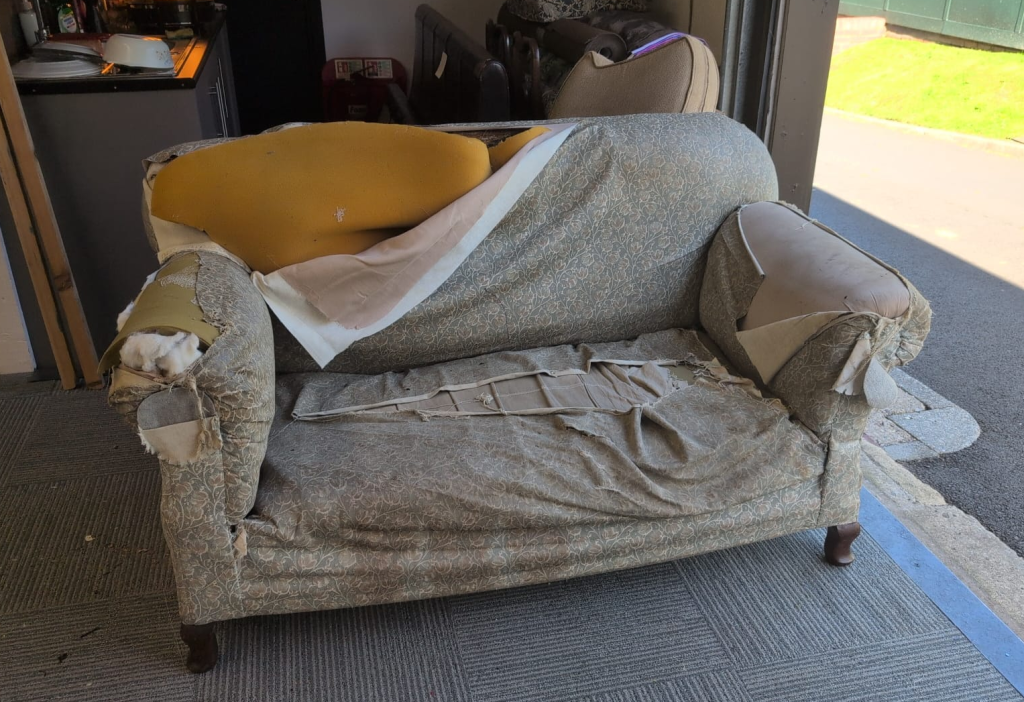
The five layers of a traditionally built sofa
A sofa from the 1940s, 50s, 60s, or 70s — the kind that ends up in our workshop on a regular basis — is essentially five layers stacked on top of a wooden frame. Once you know what they are, you understand why they last so long, why reupholstery costs what it does, and why the high-street equivalent feels so different to sit on.
1. The frame
This is the bones. On a traditional British sofa it's solid hardwood — usually beech, oak, or birch — joined with mortise-and-tenon joints, dowels, glued blocks, and screws. No staples holding the frame together. No particleboard. No "engineered wood" (which is a polite term for sawdust and glue).
A frame like this is the reason your grandmother's sofa is still going. We routinely strip back chairs that are 60-80 years old where the frame is in better condition than a five-year-old sofa from a high-street chain. When the frame is sound, everything else can be rebuilt around it.
2. The webbing
Stretched across the bottom of the seat frame, you'll find strips of woven jute or linen webbing — about two inches wide — interlaced like a basket. This is what holds the springs in place and gives the seat its first layer of support. Good webbing is tight as a drum when it's new and slowly stretches over decades. When it finally goes, the seat starts to dip in the middle. That's almost always the first sign a sofa needs attention.
3. The springs (and this is where it gets interesting)
This is the single biggest difference between a traditional sofa and a modern one. Open up an old British settee and you'll typically find hand-tied coil springs — individual cone-shaped steel springs, eight to twelve per seat, each one tied to its neighbours in eight directions with hemp twine. The eight-way hand-tied system is what gives a properly built sofa its distinctive supportive-but-soft sit. It takes hours to do by hand and almost no one builds furniture this way any more.
What you get in a modern flatpack sofa instead is serpentine springs (also called sinuous or "no-sag" springs) — long, S-shaped wires stapled across the frame in parallel rows. They're cheap to install, take minutes rather than hours, and they bounce. They don't support. They sag within five to ten years and there's no fixing them — they're not designed to be repaired.
4. The natural fillings
Here's the layer most people find genuinely surprising. Above the springs, traditional sofas are built up with natural materials: hessian (a coarse jute sackcloth) stretched over the springs to stop them poking through, then a layer of coir fibre (curled coconut husk that holds its shape for decades), then horsehair (yes, real horsehair — a bit gruesome the first time you see it, but it's an extraordinary material that keeps its bounce essentially forever), and finally a layer of cotton wadding for softness against the cover fabric.
None of this is in a modern sofa. Modern sofas use one material above the springs: foam. Usually polyurethane foam, sometimes fibre-fill in the back cushions. Foam compresses, breaks down, and is essentially landfill in eight to fifteen years. Coir and horsehair, properly maintained, last a hundred years. We've stripped back chairs from the 1920s where the original horsehair is still doing its job perfectly — we just brush it, redistribute it, top it up, and put it back.
5. The cover
The fabric you actually see is the only layer that wears out on a regular basis, and it's the easiest to replace. This is the layer most people think of as "the sofa." It's actually the least important.
Why this matters when you're deciding to reupholster
When someone asks us "is my old sofa worth reupholstering?" what we're really being asked is: are the first four layers — frame, webbing, springs, fillings — still sound? Because if they are, putting new fabric on top is the easy bit. If they're not, we rebuild whichever layers need it.
This is why a quote on an old British sofa often comes in at £900 to £1,800. It's not just fabric and labour to staple it on. We're potentially re-webbing the seat, re-tying springs that have come loose, washing and re-distributing the original horsehair, topping it up with new coir if needed, replacing the hessian, and only then getting to the cover. We've covered the full cost picture in our UK sofa reupholstery cost guide.
The result, when it's done properly, is a sofa that feels firmer and more supportive than it has in twenty years and will last another thirty. That's not marketing. That's the physics of the materials.
What you can't rebuild: the modern flatpack sofa
The honest counterpoint: if you've got a five-year-old sofa from one of the big-box high-street chains and the seat is sagging, we usually can't help you in a way that makes financial sense. Serpentine springs that have failed can't be re-tied — there's no system for tying them. The frame is often stapled chipboard that won't hold a tack. The foam has compressed and crumbled. The cover is sewn directly to the frame in ways that mean removing it destroys it.
We're honest about this when people send us photos. We've covered the full decision tree in our reupholster vs buy new comparison — the short version is that a traditionally built sofa is almost always worth saving, and a modern flatpack one is almost never worth saving. That's not a sales pitch, it's the truth.
How to tell what you've got
You don't need to dismantle anything. A few quick checks tell us most of what we need to know:
- Lift one end of the sofa. Heavy? That's hardwood frame and natural fillings. Surprisingly light? That's softwood or chipboard frame and foam.
- Look underneath. Is there a black fabric dust cover stretched across the bottom? Lift a corner. If you see jute webbing in a basket weave, that's a traditional build. If you see plastic-coated metal strips running parallel, that's serpentine springs.
- Press down hard on the seat near the front edge. A traditional sofa pushes back evenly and firmly. A failing modern sofa goes "thump" as you bottom out against the frame.
- Check for a maker's label. Anything with a recognisable British name from the mid-twentieth century — Parker Knoll, Ercol, G Plan, Stag, Younger, Greaves & Thomas — is almost guaranteed to be worth saving. We've written a dedicated guide on Parker Knoll reupholstery for that brand specifically.
The workshop reality
Strip back any quality British sofa from the twentieth century and you find evidence of someone who really knew what they were doing — pencil marks on the frame, hand-tied knots in patterns that have specific names, hessian stitched in tiny precise stitches by hand. It's a craft tradition that goes back centuries and almost no one practises it any more.
What we do, when we reupholster a piece like this, is essentially extend that craft tradition by another lifetime. The horsehair stays. The frame stays. The springs get re-tied where needed. New webbing goes in. New cover. The piece is recognisably the same sofa it was when it was built — it's just been given another forty or fifty years of useful life.
That's the bit that doesn't show up in the price quote. You're not buying labour and materials. You're buying continuity.
Curious what's inside your sofa?
Send us a photo of your sofa from the side, and a photo from underneath if you can manage it, and we'll tell you what we think it's made of and whether it's worth saving — honestly, with no obligation.
📩 Email photos to pat@greenwoodupholstery.com
📞 Or call us on 07882 014449
Free quotes within 24 hours. Greenwood Upholstery is an AMUSF-accredited workshop based in Hebden Bridge, serving Calderdale, West Yorkshire and beyond.
Greenwood Upholstery · AMUSF accredited · Hebden Bridge, West Yorkshire