26. April 2026
The Inherited Chair: Should You Reupholster Furniture You've Loved Your Whole Life?
A particular kind of email arrives in our inbox most weeks. It's usually sent late in the evening, sometimes from someone clearing out a parent's house, sometimes from someone whose chair has been in storage for fifteen years and they're finally facing the decision. The question is always the same: "Is it worth doing anything with this?" The honest answer is almost always yes — but not always for the reasons people expect.
This isn't really a price question
Most reupholstery decisions are financial. People weigh the cost of recovering against the cost of buying new and pick the better deal. We've written a whole guide on exactly that — see our reupholster vs buy new comparison if cost is your main concern.
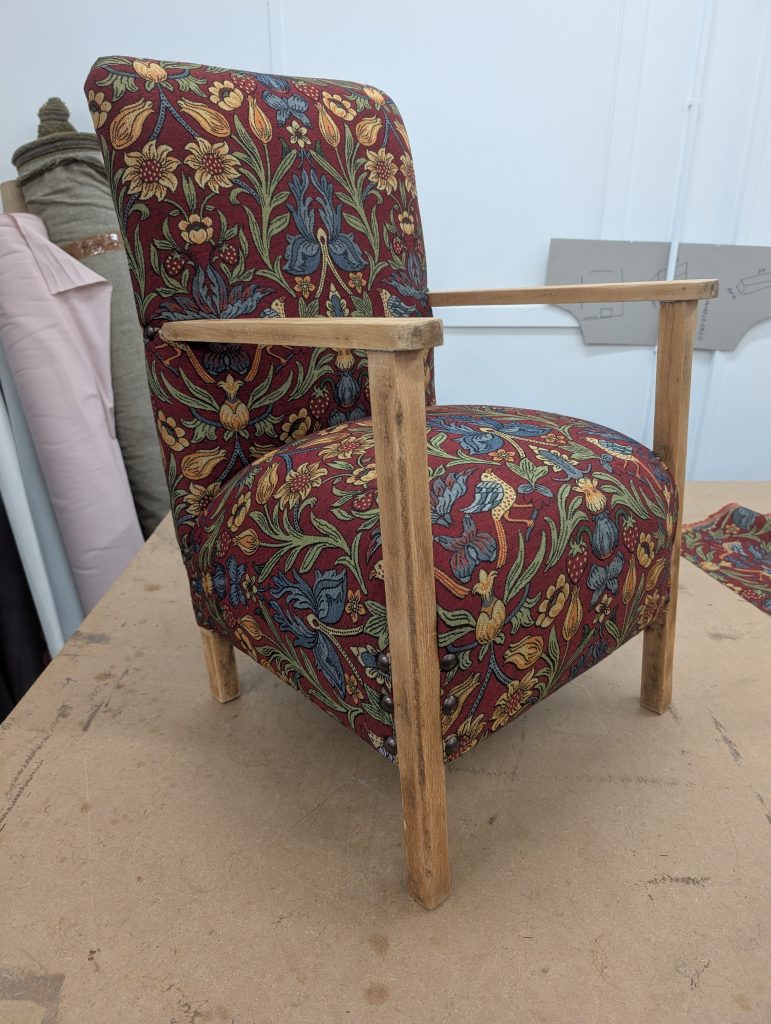
But inherited furniture isn't a financial decision. It's a question of whether to keep something. The chair your grandfather sat in to read the paper, the wing back your mum nursed you in, the little nursing chair from the spare room of a house that no longer exists — these things have weight that a price quote can't measure. The decision people are actually trying to make is: am I allowed to let this go, or do I keep it?
We can't answer that part. What we can do is take the practical questions off the table so the emotional ones are easier to think about clearly.
The frame test: is it actually worth saving?
The first thing worth knowing is that older British furniture — the kind your grandparents bought new in the 1940s, 50s, 60s, and 70s — was built to a standard almost no one builds to any more. Hardwood frames, mortise-and-tenon joinery, hand-tied springs, natural fillings. We've covered all of this in our piece on what's actually inside an old sofa. The short version: these pieces are usually built to outlast their original owners by several generations, and the bit that wears out (the cover) is the bit that's easy to replace.
You can do the basic check yourself before getting in touch with anyone:
The five-minute frame check:
- Sit in it firmly and rock side to side. A sound frame is silent or makes one quiet creak. A failing frame wobbles, knocks, or makes multiple noises from different joints.
- Lift one front foot two inches off the ground and let it drop. If the back foot lifts off the floor at the same time, the frame is rigid and sound. If the chair flexes diagonally, joints have gone.
- Look underneath. Any black dust cover usually has a corner you can lift. You're checking for: jute webbing in good colour (not rotted brown-black), springs still attached at their corners (not hanging loose), and a frame that looks like solid timber with proper joints, not chipboard with staples.
- Check the arms and back top rail for cracks. Long splits along the grain are usually repairable. Short cracks across the grain at a joint are more serious but still often fixable.
- Smell it. Damp, musty, ammonia? That's storage damage and we'll come back to it below — usually fixable, occasionally not.
If the chair passes the basic frame test, you've got something genuinely worth saving — almost regardless of how it looks on the outside.
"It's been in storage for fifteen years"
Storage damage is the single biggest worry people raise, and almost always less serious than they fear. Here's the realistic picture:
Damp and musty smell
Almost universal in stored furniture. The smell lives in the cover fabric and the top layer of cotton wadding. Both come off and get replaced in a normal reupholstery job, taking the smell with them. The horsehair or coir underneath usually airs out fine — we wash it where needed. A chair that smells like an attic when it arrives at our workshop usually smells of nothing by the time it leaves.
Mice
Common, especially in chairs stored in garages, lofts, or barns. Mice chew through cover fabric and nest inside the cushion stuffing. The damage is messy but almost entirely cosmetic from a structural point of view — the frame doesn't care. We strip the chair completely back, clean and replace any fouled fillings, and rebuild from the springs up. Adds maybe £80-£150 to a typical job.
Woodworm
The one that genuinely worries people, and reasonably so — but in our experience, most "woodworm" found on old chairs is dormant or historical. The little holes you can see were made decades ago and the beetles are long gone. Active woodworm has fresh, pale-edged holes with little piles of fine sawdust ("frass") underneath. Treatable with a borate-based treatment that takes a couple of weeks, and we can advise or arrange this. Even active woodworm rarely writes off a frame — it just needs treating before reupholstery starts.
The rare actual write-off
Honestly, the only scenarios where we say "we don't think this is worth it" are: serious water damage that's caused the frame to swell and the joints to fail; structural fire damage; or chairs from periods (briefly in the late 1980s and 90s) when even some traditional-looking chairs had stapled chipboard frames disguised by veneer. We'll know within a few minutes of opening up.
What it actually costs
A typical wing back chair, fireside chair, or nursing chair full reupholstery — including any reasonable foundation work — usually comes out at £550-£950 in labour, plus fabric. Fabric for a single chair is normally 5-8 metres at £25-£60 per metre, so add £125-£480.
For a Parker Knoll or similar named brand we'd point you to our Parker Knoll wingback guide for more specific figures. For a more general fireside chair, expect a typical total of £700-£1,300 all in.
That's less than the cost of a new mid-range armchair from a high-street chain, and the chair you get back is the one you already love, in fabric you've chosen, with another forty or fifty years of life in it.
The fabric question is more important than people realise
Here's the thing nobody tells you about reupholstering inherited furniture: you don't have to put it back in fabric your grandmother would have liked.
People sometimes feel almost guilty about choosing a fabric that doesn't match the chair's original character — putting a bold velvet on a chair that was originally beige tweed, or a modern geometric on something Victorian. As if it's somehow disrespectful to the previous owner.
It isn't. The chair stays the chair — the same frame, the same shape, the same hand-tied springs, the same horsehair. The cover is the layer that changes every thirty years anyway. Picking a fabric that you actively love, that fits your house, that makes you want to use the chair every day — that's how the chair gets a real second life rather than sitting in a corner being a memorial. Your grandmother would almost certainly rather you actually used the thing.
That said, if matching the original is what you want — we can do that too. We've recovered chairs in fabrics chosen specifically because they were what the chair "should have" had originally, and that decision works for some people. Both choices are legitimate. The point is that it's a choice, not an obligation.
One conversation worth having with yourself first
Before getting in touch with anyone (us or any other upholsterer), it's worth asking honestly: where is this chair going to live?
If the answer is "in our living room, where I'll sit in it every evening" — reupholster, with confidence. If the answer is "in the spare room, because I don't really have a place for it but I can't bear to part with it" — reupholster anyway, but consider whether the spare room is its long-term home or whether you're using the chair as storage for grief.
Sometimes the most honest version of keeping something is finding it the right home with someone else who'll actually use it — a sibling, a cousin, a younger family member starting out. That's not letting go. That's keeping it alive in a different room.
And sometimes the answer really is to let it go. We've had customers send us photos and we've gently said "this one isn't worth the work, but here's a few things to do before you part with it" — take photos, take a small piece of the original fabric for a memory box, sit in it one last time. None of that requires our services and none of that is a sales pitch. It's just what we'd say to a friend.
What we'd suggest as a next step
If you've got a chair you're trying to decide about, send us a few photos: front, side, underneath if you can manage it, and any close-ups of damage you're worried about. Tell us a bit about its history if you'd like to — what it is, who it belonged to, where it's been. We read every email properly. We'll come back with an honest opinion: worth doing, not worth doing, or somewhere in between with a few options.
We don't push people into reupholstery jobs. We turn down work we don't believe in. So when we say a chair is worth saving, you can trust the answer.
Thinking about an inherited piece?
Send us a few photos of the chair and tell us a bit about it. We'll give you our honest opinion — worth saving, not worth saving, or what your real options are. No pressure, no pushy follow-up.
📩 Email photos to pat@greenwoodupholstery.com
📞 Or call us on 07882 014449
Free quotes within 24 hours. Greenwood Upholstery is an AMUSF-accredited workshop based in Hebden Bridge, serving Calderdale, West Yorkshire and beyond.
Greenwood Upholstery · AMUSF accredited · Hebden Bridge, West Yorkshire